Article — Vermeersch, Questions on Justice
Concerning the Graphic Description of Taxes
119. Uses. To the thesis concerning the forms of taxes we append a graphic description of them,1 so that it may be discerned by the eyes themselves:
1 Rev. Fr. Schaffers, S.J., graciously prepared this for us.
1. How easily a system of taxation can be ordered mathematically which agrees with the conditions proposed at the end of no. 104, so that: a) It approaches without end toward a most moderate limit; b) The portions to be contributed from income nevertheless increase continuously; c) All citizens enjoy an exemption affecting a definite amount of proceeds—the Existenzminimum [subsistence minimum]; d) The same portions of proceeds are burdened in the same manner among all.
For the curved lines display that system; and by the diagram itself it becomes manifest what portions of taxes correspond to individual proceeds.
2. How one and the same formula can satisfy various demands: whether you intend to relieve modest fortunes more or less; whether you establish a greater or lesser limit for the increasing portions; whether the public revenues themselves appear to require increase or decrease.
This property is apparent from the very variety of the lines.
3. That it is vain to establish steps definite in number and distinguished by fixed intervals, to which the same payment is commanded, since by continuous gradations all the advantages sought from that distinction of steps can be obtained just as certainly but in a more just manner.
This is established from the two lines drawn in the left-hand corner. For the line which is interrupted into sections—the broken line—displays the system of the former method, distinguishing as many classes as are defined by Prussian law. Yet it scarcely differs from the adjacent curved line which makes the classes infinite in number.
4. That the relief which citizens of slender condition obtain from the introduced progression is by no means to be despised, even if you contain it within the narrowest limits. (Thus we refute the statement of D. Leroy-Beaulieu.) Cf. below, no. 120.5.
120. In what manner the table is arranged.
1. The mathematical formula which we have used is one of those which are adapted to curved lines that, from the point whence they proceed—which you can vary—approach a straight line without end, without ever coinciding with it (curves with an asymptote). Moreover, we chose that which displays the hyperbola.
It is expressed in this manner:
$$x = -a + \sqrt{a^2 + y^2/n^2}$$
The greater you make a, the more you favor modest fortunes, and conversely; so that if a = 0, you obtain the proportional formula y/n. But so long as a exceeds 0, however much the incomes y increase, you will never have x = y/n, although you approach it without end.
2. In making the computations, we accepted the statistical data of the progressive tax which is commanded upon income in Prussia.
By that law citizens, according to the limits—lower and upper—between which their income is contained, are distributed into 26 classes upon which a varying tax is imposed, until one arrives at those who possess more than 100,000 marks annually.2 For these are commanded to contribute 4 percent; at that quantity, as the maximum, it henceforth stops. You have here some of the steps and burdens:
2 By the letter M. we designate the German money whose name is mark and which corresponds to approximately 1.25 francs.
| Income | Tax3 | Income | Tax |
|---|---|---|---|
| 900–1,050 marks | 6 marks | 2,400–2,700 marks | 44 marks |
| 1,050–1,200 marks | 9 marks | 2,700–3,000 marks | 52 marks |
| 1,200–1,350 marks | 12 marks | 3,000–3,300 marks | 60 marks |
| 1,350–1,500 marks | 16 marks | 3,300–3,600 marks | 70 marks |
| 1,500–1,650 marks | 21 marks | 3,600–3,900 marks | 80 marks |
| 1,650–1,800 marks | 26 marks | 3,900–4,200 marks | 92 marks |
| 1,800–2,100 marks | 31 marks | 4,200–4,500 marks | 104 marks |
| 2,100–2,400 marks | 36 marks | 4,500–5,000 marks | 118 marks |
3 The numbers placed under this word display the annual tax imposed upon the entire income and not merely upon that portion which exceeds the lower limit. In other words, those who, for example, have an income of 1,075 marks are commanded to pay 9 marks, not 9 + 6.
Etc. From 100,000 marks to infinity, 4 percent is exacted.
Incomes which remain below 900 marks are exempted from every tax. Finally, for those citizens who from duties of piety toward children, parents, etc., sustain special burdens, the tax is relieved by some portion, provided that their income remains below 9,500 marks.
3. If you observe how many incomes were found in the individual classes in Prussia in the year 1897–98, and how much public money was amassed from them, you will find without difficulty that this mean amount of income corresponds to the individual classes, and that the proportional share which they are commanded to contribute can thus be estimated:
| Income4 | Number | Total amount of incomes | Acquired by the treasury in 1897–98 | Mean amount of income | Proportion exacted |
|---|---|---|---|---|---|
| 900–1,200 marks | 1,281 × 1,000 | 1,313.2 × 1,000,000 marks | 9.1 × 1,000,000 marks | 1,030 marks | 0.7 percent |
| 1,200–3,000 marks | 1,144 × 1,000 | 2,019.5 × 1,000,000 marks | 28.6 × 1,000,000 marks | 1,765 marks | 1.4 percent |
| 3,000–6,000 marks | 217 × 1,000 | 888.9 × 1,000,000 marks | 20.1 × 1,000,000 marks | 4,100 marks | 2.3 percent |
| 6,000–9,500 marks | 60 × 1,000 | 444.6 × 1,000,000 marks | 12.1 × 1,000,000 marks | 7,415 marks | 2.5 percent |
| 9,500–30,500 marks | 50 × 1,000 | 765.9 × 1,000,000 marks | 23 × 1,000,000 marks | 15,310 marks | 3.0 percent |
| 30,500–100,000 marks | 10 × 1,000 | 491.8 × 1,000,000 marks | 17 × 1,000,000 marks | 49,180 marks | 3.5 percent |
| 100,000 marks–$\infty$ | 2 × 1,000 | 445.5 × 1,000,000 marks | 17 × 1,000,000 marks | 222,750 marks | 3.8 percent |
| Total | 2,764 × 1,000 | 6,374.6 × 1,000,000 marks | 126.9 × 1,000,000 marks |
4 The data displayed in the first four columns we have borrowed from Conrad’s Handwörterbuch [Concise Dictionary], s.v. “Einkommensteuer” [“Income Tax”] (Germany).
N.B. That system is of the properly progressive kind, since the greater part of the incomes and of the public money collected is subjected to an unequal burden.
4. The same public revenue would be had by means of a proportional exaction by which 1.99 percent was commanded upon total incomes exceeding 900 marks. But if you wished to make the first portion of 900 marks immune for all, it would be necessary, in order to obtain approximately the same annual total, to exact 3.2 percent from the remaining incomes. Observe, however, that, once that immunity of the first 900 marks is granted, a true rationale of progression affecting total incomes is introduced by this fact alone. The matter is evident to one considering that 900 marks are so much a smaller portion of the total income as the whole total is greater.
5. If, in the formula placed above, you made a = 70 and took 4 percent as the limit, a system of continuous progression would give Prussia the same revenue from taxes which it now has, but smaller incomes would be spared more.
For while 1,030 paid 6 marks, by this method they would contribute 2.5; and while 1,765 paid 26 marks, they would contribute 20.7. Conversely, 4,100, which contributed 92, would now contribute 99.3 marks.
If you substitute the limit of 5 percent for the limit of 4 percent, you could make a = 200 and nevertheless collect almost the same total for the treasury. Then, however, 1,030 would bear only 1.50; 1,765, 14. You see, therefore, as we said above, no. 119.4, that this relief is not to be despised.
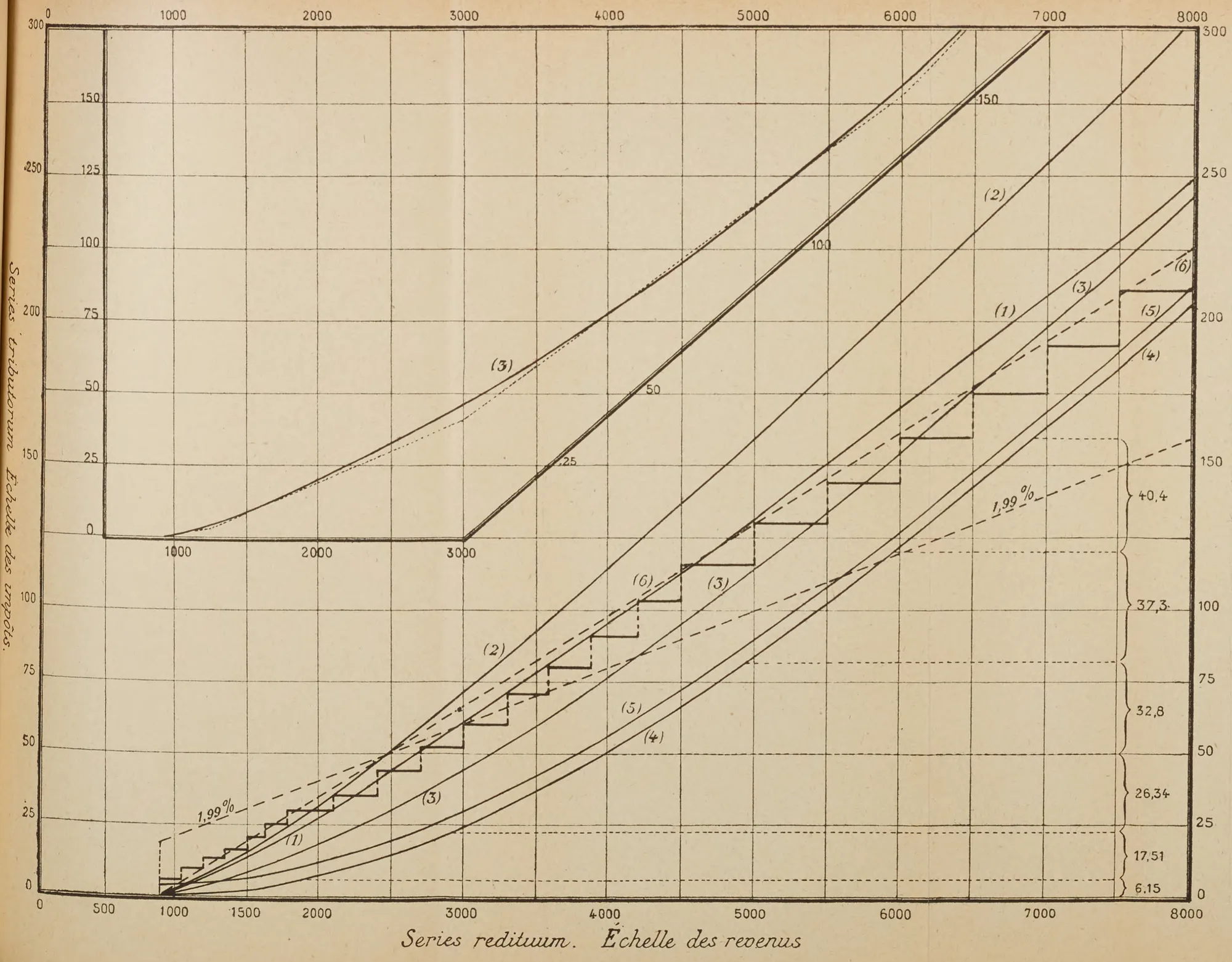
Foldout chart. The facsimile preserves the plotted curves, stepped line, scales, line numbers, percentages, and interior tax annotations exactly as printed. English translations of its inscriptions follow.
Vertical-axis labels: Series tributorum; Échelle des impôts — Scale of Taxes.
Horizontal-axis labels: Series redituum; Échelle des revenus — Scale of Incomes.
| Graphic inscriptions | Values printed in the chart |
|---|---|
| Curves and lines | (1), (2), (3), (4), (5), (6) |
| Proportional-rate inscription | 1.99 percent |
| Main income scale | 0; 500; 1,000; 1,500; 2,000; 3,000; 4,000; 5,000; 6,000; 7,000; 8,000 |
| Main tax scale | 0; 25; 50; 75; 100; 150; 200; 250; 300 |
| Inset income scale | 0; 1,000; 2,000; 3,000; 4,000; 5,000; 6,000; 7,000; 8,000 |
| Inset tax scale | 0; 25; 50; 75; 100; 125; 150 |
| Interior tax annotations at the right | 6.15; 17.51; 26.34; 32.8; 37.3; 40.4 |
a) By the line which imitates a staircase, the steps of the tax which is imposed upon incomes by Prussian law and annually brings 127,000,000 marks to the treasury of that kingdom.
b) By two straight lines, which are marked with broken signs (— — —), taxes of the proportional form:
α) One of these takes 1.99 percent from the whole income of everyone, except those whose annual proceeds remain below 900 marks. From this tax the same return would be obtained—127,000,000 marks—as from the preceding one.
β) The other, however, marked (6), exacts 3.2 percent from everyone’s income, except that the first portion of each person’s income, valued at 900 marks, is exempt. It was therefore necessary to increase the proportional share of the tax so that it would produce approximately the same return.
c) By five curved lines, taxes of the progressive form, which correspond to the formula
$$x = -a + \sqrt{a^2 + y^2/n^2},$$
in which x displays the portions of taxes which are exacted from the individual portions of incomes; y stands for the incomes themselves; 1/n for the mathematical limit; and a for the quantity upon which the manner of curvature depends (French: l’allure de la courbe, “the course of the curve”). Hence, if you set a = 0, the line becomes straight and you fall back into the proportional system, as is indicated by the formula itself: x = y/n.
Moreover, in line (1), a is set at 70, and the limit at 4 percent. It would bring Prussia 125,000,000 marks.
Moreover, in line (2), a is set at 100, and the limit at 5 percent. It would bring Prussia 152,000,000 marks.
Moreover, in line (3), a is set at 200, and the limit at 5 percent. It would bring Prussia 122,000,000 marks.
Moreover, in line (4), all things are set as in (3), but the tax is calculated from proceeds from which 900 marks have been deducted; whereas, in the first three cases, it was calculated from whole incomes and, once the total of the taxes had been obtained, only then was the portion corresponding to an income of 900 marks removed. By form (4), only 100,000,000 marks are acquired for the treasury.
Moreover, in line (5), all things are set as in (4), but the same sum of 5 marks is added to each individual tax.5 In this manner 124,000,000 marks are obtained.
5 This sum of 5 marks is the tax which, according to the same formula, would have to be paid for 900 marks.
2. In the left-hand corner, you again have curve (3), beside which is placed a line broken into segments (French: droite brisée, “broken line”), which displays a form composed of steps (French: impôt par tranches, “tax by brackets”) having the same return. The steps, moreover, are distinguished thus:
| Income | Tax | Income | Tax |
|---|---|---|---|
| 900–1,200 marks | 0.7 percent | 6,000–9,500 marks | 2.5 percent |
| 1,200–3,000 marks | 1.4 percent | 9,500–30,500 marks | 3.5 percent |
| 3,000–6,000 marks | 2.3 percent | 30,500–100,000 marks | 3.5 percent |
| 100,000 marks and thereafter | 3.8 percent |
3. The numbers which are arranged at the right, beside the descending line, and are inside the diagram—6.15, 17.51, etc.—show which portions of taxes correspond to portions of incomes. For the exterior numbers—0, 25, etc.—indicate the various total sums which must be paid upon each person’s whole income.6
6 For example, the portion from 900 to 1,900 is burdened by 6.15; the portion from 1,901 to 2,900 bears a burden of 17.51; the portion from 2,901 to 3,900 must pay 26.34. In total, 50 is owed, as the exterior number has it.
The same interior numbers make it manifest that the portions of tax which are imposed upon similar portions of incomes do not vary according to the total of the incomes, but that the same portions are exacted from each person. Thus, for example, the portion of incomes which is contained between the second and third of the horizontal lines is assessed as burdened by 26.34 marks, whatever at last the total of the incomes may be.